
Ceramic vs Titanium Implants: a holistic comparison
If you're choosing between zirconia ceramic and titanium dental implants, the decision is more than cosmetic. Here's how the two materials compare on biocompatibility, aesthetics, longevity and cost — from a practice that has placed both.
In short
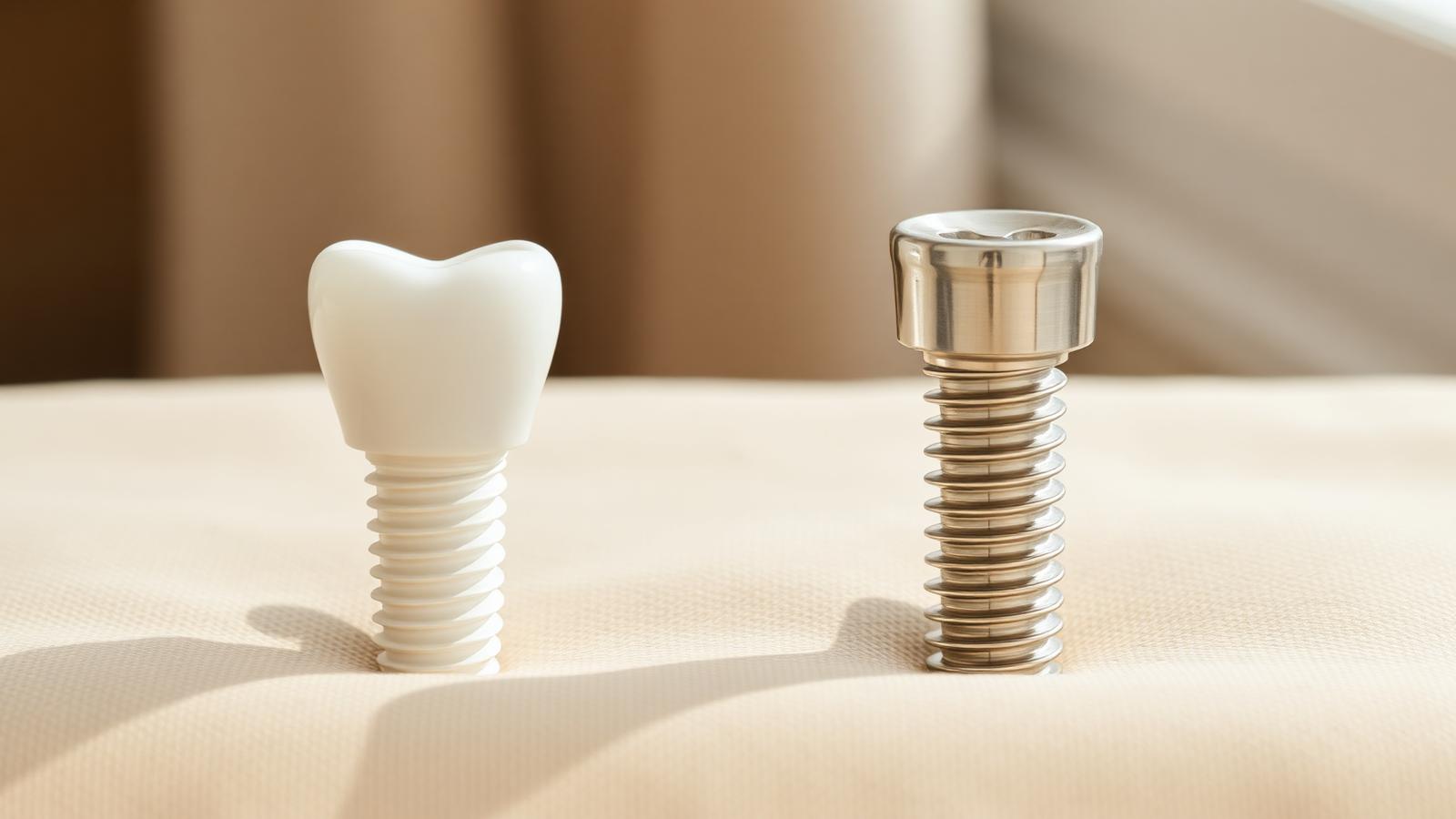
Titanium is the long-standing standard: strong, well-studied and versatile. Ceramic (zirconia) is the metal-free alternative: biocompatible, aesthetic, and increasingly the choice for health-conscious patients. For most single-tooth cases today, ceramic is a clinically proven option — and often the better one when whole-body health is part of the equation.
What each implant is made of
A dental implant is a small post placed in the jawbone to replace a missing tooth root. The material of that post determines how your body reacts to it long-term.
- Titanium implants are a metal alloy — usually Grade 4 titanium or Ti-6Al-4V (containing aluminum and vanadium). They've been the industry default since the 1960s.
- Ceramic implants are made of zirconium dioxide (zirconia) — a tooth-white, non-metal ceramic. They've been in clinical use in Europe since the mid-2000s and are FDA-cleared in North America.
Side by side
Metal-free option
Ceramic (Zirconia)
Pros
- 100% metal-free — biocompatible zirconia
- Tooth-white color, no grey gum line
- Non-corrosive, no ion release into tissue
- Low plaque affinity — gentler on gums
- Ideal for patients with metal sensitivities
Cons
- Higher upfront cost
- Fewer specialists trained to place them
- Mostly one-piece designs limit angulation
Traditional standard
Titanium
Pros
- 50+ years of clinical data
- Widely available, more affordable
- Two-piece designs allow flexible restorations
- Excellent for complex full-arch cases
Cons
- Metal — can show through thin gum tissue
- Documented (rare) titanium sensitivity
- Possible galvanic reaction with other metals
- Corrosion under acidic or inflamed conditions
At a glance
| Criterion | Ceramic (Zirconia) | Titanium |
|---|---|---|
| Biocompatibility | Excellent, metal-free | Very good, rare sensitivity |
| Aesthetics | Tooth-white, no grey line | Metal can show through gum |
| Strength | Excellent for single teeth | Excellent for all cases |
| Long-term data | 15+ years | 50+ years |
| Plaque affinity | Low | Moderate |
| Corrosion | None | Possible in inflamed tissue |
| Cost | Higher | Standard |
| Design flexibility | Mostly one-piece | One- or two-piece |
The biocompatibility question
Titanium has an excellent safety record, but it is still a metal. Under conditions of inflammation, acidic saliva, or contact with other dental metals, titanium can release microscopic ions into surrounding tissue. In most patients this is inconsequential — but for the small subset with metal sensitivity, an autoimmune condition, or those pursuing a low-toxic-load lifestyle, it matters.
Zirconia is bio-inert. It does not corrode, does not release ions, and no documented allergic reaction to zirconia has been reported in dental literature to date. That's why we favor ceramic implants for patients who prioritize whole-body health.
Aesthetics and gum health
Titanium is dark. When gum tissue is thin — or recedes over the years — the metal can telegraph through as a grey shadow at the gum line. Zirconia is tooth-white, so even a receding gum reveals a natural-looking root.
Ceramic surfaces also attract less plaque than titanium, which supports healthier gum tissue around the implant over time.
Longevity and clinical evidence
Titanium has 50+ years of clinical data and remains the gold standard for complex, multi-unit or full-arch restorations. Zirconia is newer to market, but long-term studies now report survival rates above 95% at 5–10 years for single-tooth cases — on par with titanium.
For most patients replacing one or a few teeth, both options are clinically successful. The tie-breaker becomes biocompatibility and aesthetics.
Which one is right for you?
Choose ceramic implants if you:
- Have a metal sensitivity or autoimmune condition
- Follow a holistic or low-toxic-load lifestyle
- Have thin gum tissue where a grey line would show
- Want a fully metal-free mouth
Titanium may still be preferred if you:
- Need a complex full-arch or multi-unit bridge
- Require an angled restoration a one-piece design can't accommodate
- Have specific bone-density considerations your dentist flags
Talk to us
Not sure which implant is right for your smile?
Dr. Carl Benoit has placed both ceramic and titanium implants for 35+ years in Westmount. Book a consultation to review your options in person.